History has so many untold stories.
Question the story.Question the technology.
A hands-on project where history meets technology — helping students become more critical about both the stories they hear and the technology that creates them.
Full curriculum available from 15 October 2026 — free.
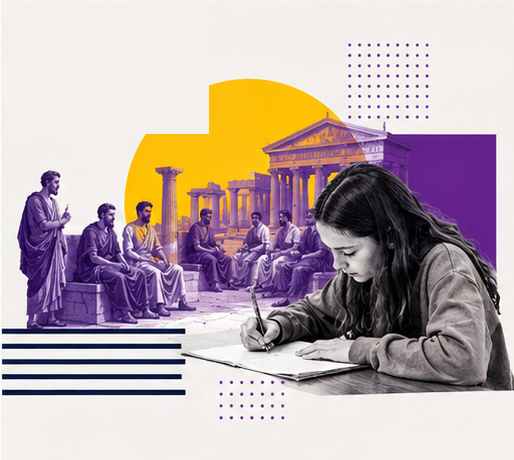
See it in action
Find the perspective the starting story leaves out.
It starts with an event, situation or documented object. Students ask whose perspective is missing — learning to separate what the evidence establishes, what they can reasonably infer, and what remains unknown. Then they create a defensible story and examine what their tools added or could not decide.
Filmed with Museumpark Orientalis · A museum partner is optional — a specific historical event, source, archive, photograph or documented object can work
What is Untold Stories?
Your history topic. Our process.
A ready-to-use project for secondary history classrooms — built as a compact core you can extend as far as you want to go.
6
connected phases
One investigation from FIND to REFLECT, fitted to your timetable.
1
optional deepening route
Add UNDERSTAND after COMPARE; production time depends on the format.
You choose a topic from your curriculum. We provide the lesson activities, teacher guidance and optional AI routes. Printable canvasses and short instructional videos will connect directly to each phase as their final files are released. No previous AI experience required.
- Ages 13–17
- Any history topic
- Paper-first activities
- Works without AI too
- Open, CC BY-SA
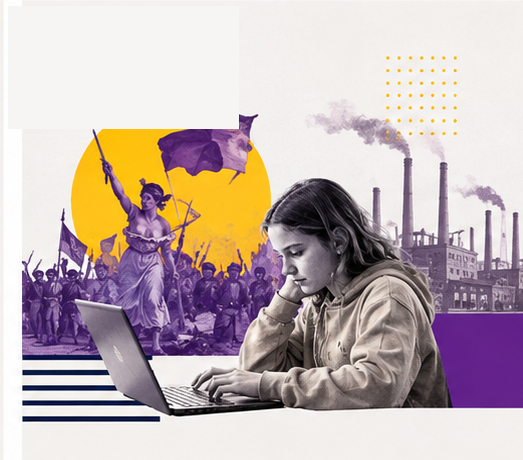
Any era. Any topic you already teach.
Five examples — the process fits them all.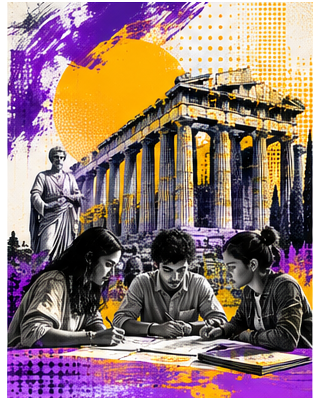 Ancient Greece & Rome
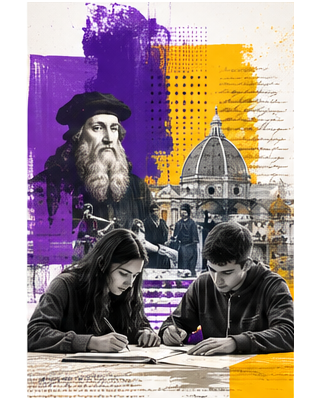 Renaissance & Enlightenment
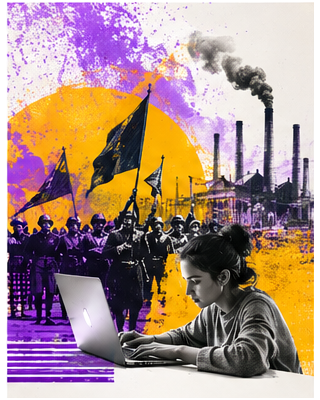 Revolutions & Industry
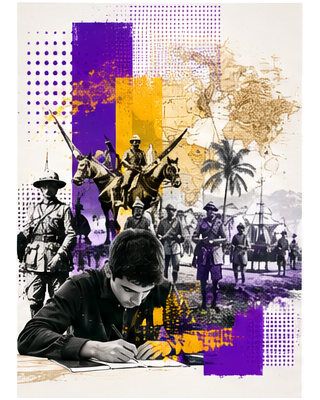 Colonialism & WWI
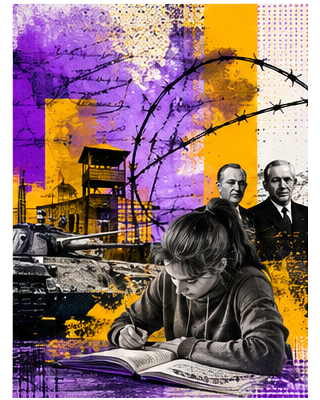 WWII & Cold War
Students work through six steps:
- 01
Find
Notice the perspective the starting story leaves out.
- 02
Check
Test what the sources can and cannot tell you.
- 03
Compare
Put two perspectives side by side and build a claim.
- 04
Draft
Plan the story and its evidence together.
- 05
Create
Make the story in a format that fits your class.
- 06
Reflect
Explain what changed and what remains unknown.
Students might create a video, comic, story, poem or other digital artifact — but the real outcome is learning to create, question and verify.
Join our webinar (opens in a new tab)Ready to use in your classroom
Everything you need to run it. Nothing you have to buy.
Untold Stories is a complete, classroom-ready project — free and open. Sign up and we'll send you the full curriculum the moment it launches, plus your invitation to the launch webinar.
- Complete lesson materialsStudent instructions and matching teacher guidance for six connected phases, with printable canvasses added as final files are released.
- Step-by-step tutorial videosShort student walkthroughs are being added phase by phase. The written activities remain usable without a video.
- Worked examplesIllustrative outputs make the evidence standard visible before students make their own.
- AI-tool agnosticNothing is locked to one platform. Use whichever tools your school already allows.
- An unplugged routeA full no-AI version of the curriculum for schools without access, or lessons where the tools fail.
- Monthly check-in webinarOnboarding, Q&A, training and a place to exchange stories with other teachers across Europe.
Get the curriculum
Free, open and sent straight to your inbox at launch.
Send me the materials (opens in a new tab)Available from 15 October 2026. We'll email you at launch and invite you to the teacher community webinars. No spam, unsubscribe any time.
Curriculum launch
15 October 2026
Thursday · 15:00–16:00 CET
We walk through the whole curriculum, show what students made, and answer anything you ask before you commit a lesson to it. Start here.
Save my seat (opens in a new tab)Then, teacher community webinars · 16:00–17:00 CET
- 9 Nov 2026Mon
- 14 Dec 2026Mon
- 11 Jan 2027Mon
- 8 Feb 2027Mon
- 8 Mar 2027Mon
- 18 Mar 2027ThuFinal event
Questions teachers ask
Q&A
Do I need a museum to run this?
No. The first pilot and filming took place with Museumpark Orientalis, but a museum partner is entirely optional. The curriculum can start from a local archive, a photograph, a document, a monument down the road, a historical situation or a documented object from your own classroom.
Do I need AI tools, a subscription or a budget?
None of the three. The curriculum is tool-agnostic — use whatever your school already permits, free or paid. There is also a complete unplugged route that runs the entire project without any AI, which doubles as your backup when the tools are blocked or simply stop working mid-lesson.
Do students need devices — and what if we do not have enough?
For the investigation, source work and writing, no: pen, paper and the printed canvasses are enough. The reel, comic and simulation routes need a suitable device, while the low-tech CREATE route reaches the same historical learning objective without one. Where access is limited, you can also share devices in small groups or schedule digital production separately. Choose the route that fits your school setting.
Do I need to know anything about AI myself?
No previous AI experience is required for the historical inquiry or the unplugged route. The teacher guidance models each activity, the digital CREATE pages contain their production recipes, and short student walkthroughs will be added as they are completed. Your expertise stays where it belongs: the history, sources and judgement.
How much teaching time does it take?
The curriculum has six connected phases rather than a fixed lesson count. FIND is short with the material prepared; CHECK, COMPARE, DRAFT and REFLECT each fit roughly one lesson; optional UNDERSTAND adds depth; and CREATE varies from a compact paper route to a multi-session digital production. Fit the route and output to your timetable.
Which age group is it for?
Students aged 13 to 17. Two difficulty levels are built into the materials so the same project can run in a younger and an older class without rewriting it.
How does the course align with national curricula?
The course is designed for secondary education and aligned with national standards in Belgium, Greece, and the Netherlands. It combines learning goals from history and technology, with relevant language learning goals included where they fit national curricula.
What are the learning outcomes for students?
Students learn to identify and interpret sources, compare historical perspectives, distinguish evidence from inference, use context without mind-reading, keep uncertainty visible and create a defensible account. Where AI is used, they also learn to question its additions and remain responsible for the historical judgement.
What do students actually produce?
Students choose one route: a reel, comic, game or simulation, or an unplugged/low-AI story such as a written or illustrated narrative, poster, live reading or recorded audio. The product matters less than the reasoning behind it: students keep the evidence trail, qualify inferences and name what remains unknown.
What does it cost, and can I adapt it?
It is free. Everything is published under a CC BY-SA open licence, so you may translate it, remix it and adapt it to your curriculum, your objects and your language — as long as you share your version under the same terms.
When can I start?
The full curriculum launches on 15 October 2026, with a launch webinar the same day at 15:00–16:00 CET. From 9 November the teacher community meets monthly at 16:00–17:00 CET, closing with the final event on 18 March 2027. Sign up and everything comes to you.
Who it's for
Built for one classroom. Open to everyone.
History teachers
One project covering multiperspectivity, source criticism and AI literacy — with materials, timings and teacher notes included.
Students aged 13–17
Teams recover a person history left out, build them from evidence, and learn to tell their own thinking apart from the machine's.
Museums & teacher trainers
Every canvas, prompt and training session is open under CC BY-SA. Adapt it to your collection, your objects, your language.
From the first classrooms
It has already been run by students.
Students from Merletcollege (NL) and Sint-Lievenscollege (BE) ran the full project together in May 2026 — and presented what they made, and what the technology got wrong.


