Video
Teacher guide · Phase 6
REFLECT · Return to the evidence, not the polish
Students explain changes in understanding, challenge interpretations against evidence, retain uncertainty and evaluate what their tools could and could not decide.
Videos
Canvas / worksheet
Use this worksheet to guide the activity. Watch the videos, then download or print the PDF. You can also follow the instructions online below.
Before class, print or share the PDF shown here. During this phase, play the walkthrough, then have students complete its canvas using your prepared material. Keep the completed PDF with their sources for the next phase. The online steps below provide extra facilitation guidance.
PDF
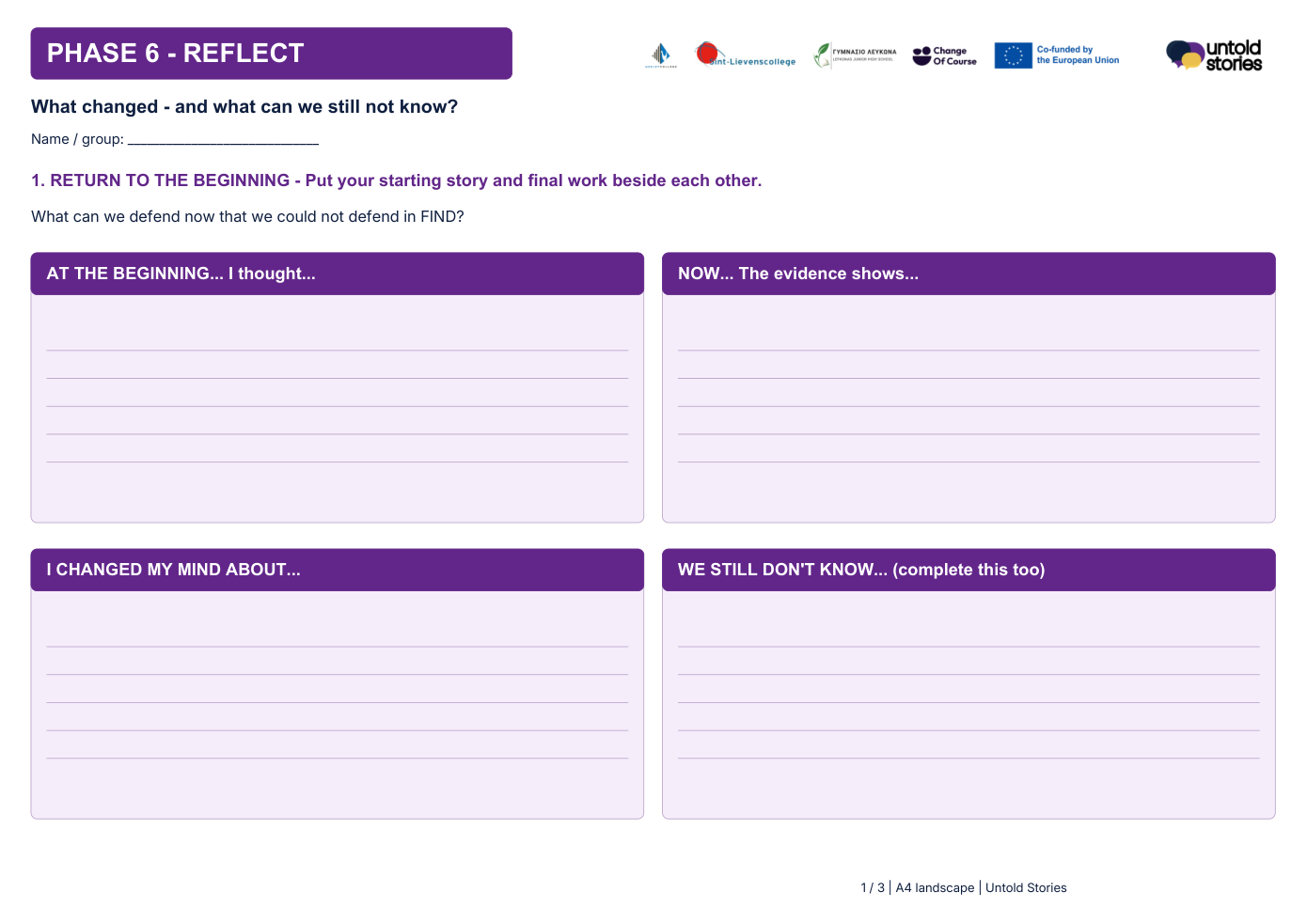
REFLECT canvas
Use in REFLECT after CREATE to review the finished story, evidence and any AI use. Choose the low-tech canvas instead for a no-AI route.
English
Scroll across the preview to read it, or download the PDF to zoom and print.
PDF
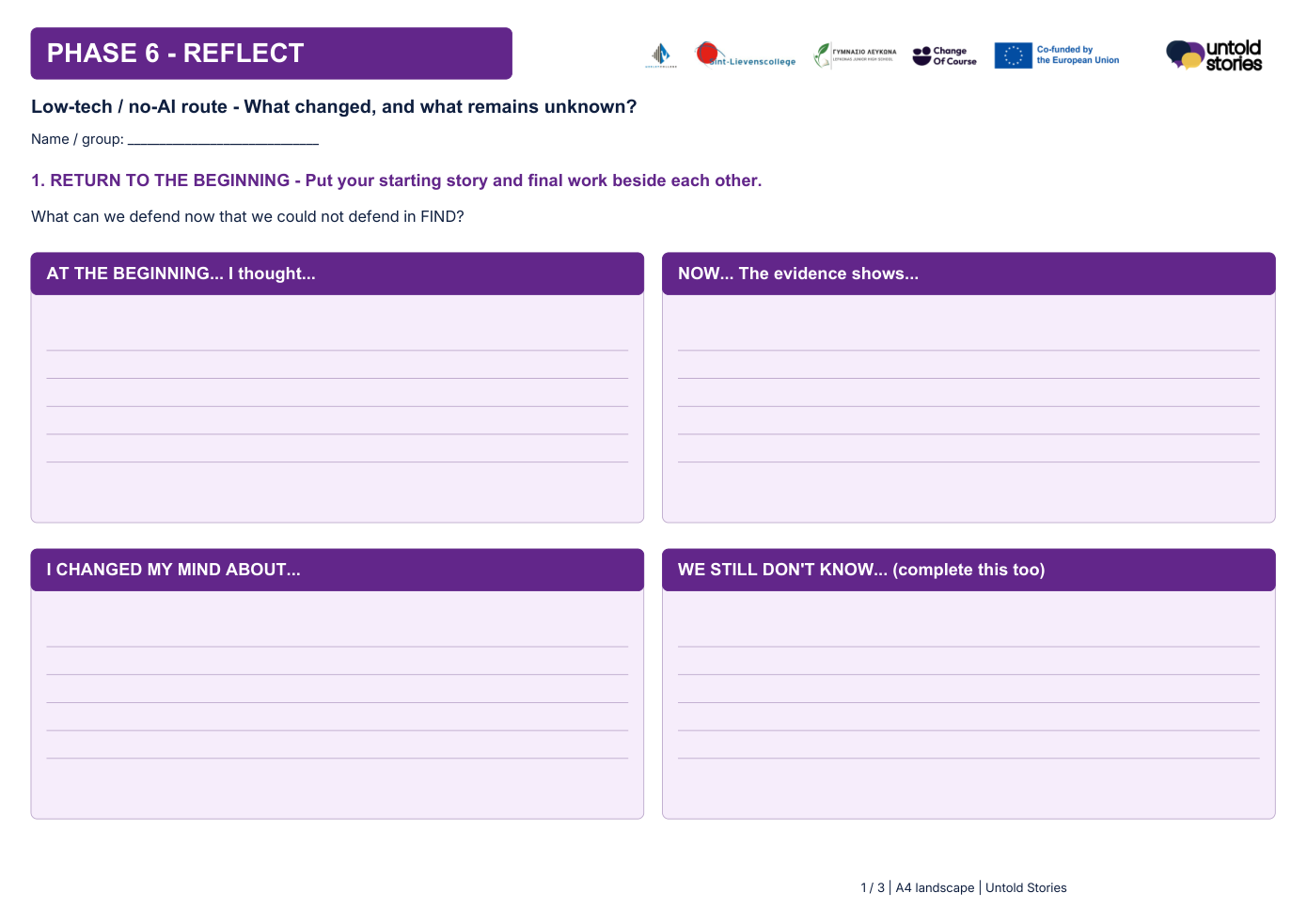
REFLECT · Low-tech / no-AI canvas
Use in REFLECT for a low-tech or no-AI route. Bring the finished story, corrected DRAFT and original FIND material.
English
Scroll across the preview to read it, or download the PDF to zoom and print.
Follow the instructions onlinePrefer working on screen? Open the steps and copy the prompts below.
Before the lesson
- Bring the exact FIND story, first ideas, final products, DRAFT sheets and sources.
- Include initial AI images or assumption sketches only where students actually made them. Do not manufacture a retrospective “first” image.
- Print the three-page REFLECT sequence.
- Pair groups for evidence-based exchange and identify two with the same or related history for step 4.
- Students answer either the AI audit or the no-AI tool questions, not both.
Guide the six steps
- Return · 5 min. Ask what can be defended now that could not be defended in FIND. Require the WE STILL DON’T KNOW box.
- Two Portraits · 10 min, conditional. Compare the initial assumption with the final representation. Ask what evidence corrected, supported or could not resolve. Focus on assumptions, not visual quality.
- Exchange · 12 min. Reviewers identify the main idea, one strongly supported part and one “How do you know?” moment. Creators answer KNOW / THINK / DON’T KNOW with reasons.
- Two defensible stories · 5 min. Elicit differences in perspective, sources, question, emphasis and interpretation while keeping the shared evidence boundary.
- Tool audit · 8 min. AI users describe help, errors/oversimplification, checks, rejections and work possible without AI. If a prompt does not apply, they say so. No-AI students explain what their tools could and could not decide.
- Final question · 5 min. Did the class recover the untold story: yes, partly or no? Reasons matter more than a preferred answer.
If step 2 is skipped, use released time for the exchange and discussion. Do not invent a substitute activity merely to fill the period.
Close carefully
Students did not recover everything someone thought, felt or experienced. They investigated a perspective omitted by the starting story and reconstructed what the surviving evidence permits. Some matters became clearer, some remain uncertain and some may never be known.
CHECKFinal student sentence
The most important thing I learned from the evidence was…